Main perimeter
Enter your data and press Calculate

Compute triangle perimeter by adding the 3 sides. Includes triangle inequality validation and unit conversion.
Pick the data you know: three sides, two sides plus the included angle, or an equilateral side.
Returns main perimeter, semiperimeter, normalized sides and Heron area with instant conversions to mm, cm, m, in and ft.
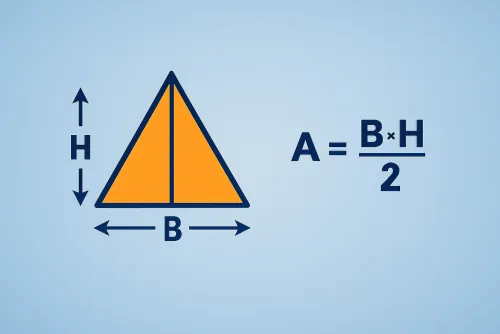
The triangle is drawn at relative scale with the three calculated sides and a reference height.
The perimeter is the sum of the three sides: P = a + b + c. When you know two sides and the included angle, apply the law of cosines to find the remaining side: \( c = \sqrt{a^2 + b^2 - 2ab\cos C} \). For an equilateral triangle, multiply the side by three: \( P = 3a \).
This tool normalizes your unit, computes semiperimeter and Heron area automatically, and shows instant perimeter conversions to mm, cm, meters, inches and feet. Use the decimals control to match the precision you need.
With sides 5.4 cm, 7 cm and 6.2 cm, the perimeter is \( P = 18.6\ \text{cm} \). The semiperimeter is \( s = 9.3\ \text{cm} \) and Heron’s formula gives an area close to \( 16.6\ \text{cm}^2 \). Using the angle option you could input two sides plus the angle to get the same result.
You can enter three sides, two sides with the included angle, or a single side for an equilateral triangle. The calculator fills the missing side and validates the angle.
The law of cosines finds the missing side when an angle is provided. Heron’s formula delivers the area and the perimeter is the direct sum of the three sides.
Meters, centimeters, millimeters, inches and feet are available. Choose one input unit to see the main perimeter in that unit plus the other conversions.
Improve this calculator
Send us the example so we can review this calculator and turn real cases into improvements or automated tests.