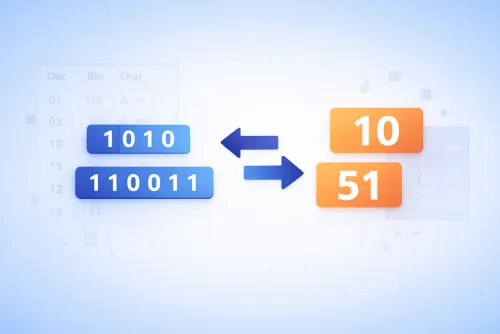
Decimal to binary converter
Convert decimal to binary with BigInt, configurable padding and two’s complement. Review successive division steps and get hex and octal outputs.
Decimal to Binary Calculator Online (Step-by-Step)
Convert decimal to binary with BigInt, add custom padding, get hex/octal equivalents, and review the repeated division steps. Everything is stacked vertically for a distraction-free flow.
Binary
Grouped binary
Signed binary (two's complement)
Hex with padding
Octal
Automatic steps: repeated division by 2
| Dividend | Quotient | Remainder | Step |
|---|
How to convert decimal to binary
The manual method divides by 2 repeatedly and stores the remainders; they are read in reverse order. For negative numbers, apply two's complement with the chosen bit width.
- Clean the input. Remove spaces, underscores, and duplicate signs; keep only digits and an optional leading sign.
- Take the magnitude. Work with the absolute value to build the unsigned binary.
- Divide by 2. Record the quotient and remainder (0 or 1) on each step.
- Iterate. Use the new quotient as the dividend until it reaches 0.
- Read backwards. The unsigned binary is the sequence of remainders from last to first.
- Two's complement. If the decimal is negative and you pick a bit-width n, pad the magnitude to n bits, flip all bits, and add 1. If the magnitude does not fit in n bits, you'll be prompted to increase the width.
Positive example (10973): successive divisions produce remainders 1 0 1 1 1 0 1 1 0 1 0 1 0 1; in reverse order they form 10101011011101.
Negative example (-25) with 8 bits: the magnitude is 11001, padded to 00011001, inverted to 11100110, and adding 1 gives 11100111.
Frequently asked questions
Improve this calculator
Found an error or missing a feature?
Send us the example so we can review this calculator and turn real cases into improvements or automated tests.